Posted on Leave a comment

Pope Benedict and “Gender Theory”
and the Threat to Civilization

Tower Church Stallions  - ESDomingos / Pixabay

Pope Benedict XVI, in his 2012 Christmas address to the Roman Curia, warned against what is called “Gender theory.” The acceptance of such theories defies both God and nature.

Pope Benedict warned regarding gender theory, “According to this philosophy, gender is no longer a given element of nature that a man has to accept and personally makes sense of it; [rather] it is a social role that we choose for ourselves, while in the past it was chosen for us by society.”

In other words, those who promote gender theory falsely claim there was never any such thing as a masculine nature or a feminine nature that defines us since conception. Rather society chose these gender roles for us. Gender is not something that is found inside of man as part of his essence, but rather, is imposed from the outside. We are now at the point where the individual decides these gender roles for himself.

“The profound falsehood of this theory, and of the anthropological revolution contained within it is obvious,” says Benedict. “People dispute the idea that they have a nature, given by their bodily identity, that serves as a defining element of the human being. They deny their nature and decide that it is not something previously given to them, but they make for themselves.” 

The Pope then appeals to Genesis.

“According to the biblical creation account, being created by God as male and female pertains to the essence of the human creature. This duality [male and female] is an essential aspect of what being human is all about, as ordained by God. This very duality as something given is what is now disputed.”

Benedict goes on to lament, “The words of the creation account: ‘male and female he created them’ (Gen 1:27) no longer apply. No, what applies now is this: it was not God who created them male and female – hitherto society did this, now we decide for ourselves. Man and woman as created realities no longer exist. Man calls his nature into question. From now on he is merely spirit and will.”

This is a key point. Truth and reality are no longer centered on man’s nature. Rather, truth and reality are now centered on man’s will. If man wills to choose his gender, or act contrary to his gender, he must be free to do so. Man chooses his own false “reality.”

Pope Benedict then explains the disastrous effects wrought on the family.

“But if there is no pre-ordained duality of man and woman in creation, then neither is the family any longer a reality established by creation.”

Thus the family as God established, which is father, mother and children, can also be changed by human will. Man will believe he can define the family any way he wants.

Pope Benedict then drives home the point: Gender theory is ultimately a revolt against God and man. “When the freedom to be creative become the freedom to create oneself, then necessarily the Maker is denied and ultimately man too is stripped of his dignity as a creature of God … When God is denied, human dignity also disappears.”

The New Bullies

The dignity of man is thus “stripped” when transgenderism becomes an accepted component of society. In the United States and elsewhere there are parents who encourage young children to choose their own gender, encourage boys to adopt girls’ clothes and mannerisms, and vice versa. Our children are also exposed to transgender men using girls’ bathrooms, and worse.

One of many examples: At Hillsboro High School in Missouri, early September 2015, a homosexual male student started to wear a wig and skirt, claimed to be female, called himself “Lila” and insisted on using the girls’ locker room.

The girls were rightly horrified. Hundreds of students walked out in protest. The boy’s response was to accuse these normal girls of bigotry.

“They are claiming that they’re uncomfortable,” said “Lila” to a local TV station, “I don’t believe for a second that they are. I think this is pure and simple bigotry. I wasn’t hurting anyone and I didn’t want to feel segregated out.”

Predictably, the politically correct School Administration sided with the homosexual boy, who eventually dropped gym class, but continues to use the girls’ bathroom.

Worse, liberals across the United States defend “Lila” and denounce his classmates’ natural reaction.  This and worse is what’s in store with the increased public acceptance of “transgenderism.”

Pope Benedict’s observation is correct. When we defy nature, the Maker is necessarily denied, and man too is ultimately “stripped of his dignity as a creature of God,” and loyal Christians will be mocked and persecuted.

Posted on Leave a comment

Teenagers and “Teenage Culture” -Part 3 of 3

Pokemon Games Digital Electronics  - natureaddict / Pixabay

Part 3 of 3: Differed Maturity

Differed Maturity

In fact, thanks to the pop-culture and modern education, differed maturity is so extreme that the National Academy of Sciences in 2002, redefined adolescents as the period extending from the onset of puberty (around 12 years of age) to age 30.25 The MacAuthur Foundation went ever further, “funding a research project that argues that the ‘transition to adulthood’ doesn’t end to the age of 34.”26 

Diane West writes in her 2007 book The Death of the Grown-up, “More adults, ages eighteen to forty-nine, watch the Cartoon Network than watch CNN. Readers as old as twenty-five are buying ‘young adult’ fiction written expressly for teens. The average video gamester was 18 in 1990, now he’s going on 30.”27 

Even World Youth Day, whose fatal flaw is that it panders to the youngsters’ rock’n’pop-culture rather than give youngsters the reasons and tools to oppose it, has likewise redefined youth. A “youth” is defined by World Youth Day organizers as between the ages of 16 and 34!28 This is unspeakably pathetic, as it is an acceptance of deferred maturity that we must combat, not capitulate to. 

What We Can Do 

There is much more to be said, including further study of the grotesque marketing techniques aimed at teens and “tweens”, which will be discussed in future issues of CFN. Here I will close with the hazardous attempt at offering a series of suggestions that parents may employ. 

In making these suggestions, I assume the parents are encouraging their children to attend the true Latin Mass, frequent the sacraments, cultivate the supernatural life of sanctifying grace, daily family Rosary, modesty in dress, and that parents either home- school or have their children enrolled in good private schools where the advocacy of virtue is paramount.29 Above and beyond this minimum, here are a few detailed suggestions, which are by no means an exhaustive list: 

1) Graces of Matrimony 

If we are married in the Church in a valid, sacramental marriage, we have a tremendous reservoir of special sacramental graces particular to the Sacrament of Marriage that we can call upon to help us live our lives as Catholics; help us raise our children in the Faith; and to give us the strength to withdraw as much as possible from the popular culture.
The Redemptorist Father T.E. Tobin, in his beautiful work, “Are You Using the 

Graces You Received at Matrimony?”, teaches that Marriage gives us a special, sacramental grace. Husbands and wives have a right to call upon this grace we need light for our mind in making family decisions, strength for the will to carry out our duties of state and to carry out our duty to raise our children from the faith and protect them from bad influences. 

Father Tobin writes, “…you have a right to the actual grace of God which you need to act in accordance with your vocation. The sacramental grace of Matrimony will enable you to act rightly as husband and wife, and later on, God willing, as father and mother. You will be able to depend upon special light for your minds and powerful strength for your wills in order to fulfill your duty.”30 

In order to receive these graces, Father Tobin writes, we have to ask for them. We also must cooperate with these graces when they are given. Pope Pius XII once lamented that the grace of the sacrament of matrimony “often remains an unused talent hidden in the field,”31 and the Pope encouraged Catholic husbands and wives to remember this grace to cultivate it. 

2) Vigilance Concerning Good Companions 

Our teaching sisters prior to the Vatican II revolution always told us: seek good companions and avoid bad ones. The old saying is true, we become like the company we keep. Thus it is important for parents; especially those who have children of a sanguine temperament, to remain vigilant in assuring their adolescents form good companions, and shun bad companions. The great Master of Thomistic philosophy and theology, Father Austin Woodbury, explains: “The influence of friends is especially great upon us, and above all upon the youthful, for by the love of friendship we penetrate within our friend, making his will our will and holding him for another self. … [W]e are drawn upwards by a good and noble friend, and downwards by a base and ignoble one.”32 

3) Television 

I am a strong advocate of having no television networks in the house: no cable and no standard antenna. This is a policy my wife and I follow since we were first married. We do have a monitor where we can view of DVD or our choice, but we can’t watch the networks if we wanted to (and who wants to). It is a magnificent freedom that I can’t recommend highly enough. Bad companions draw us downwards, and so can base and ignoble characters on television draw us downwards. If we become like the company we keep, do we want our daughters spending viewing time with Snooki and the other white trash that populate MTV’s vile Jersey Shore program?
In fact, “Jersey Shore” is only one of the thousands of television programs to be 

avoided at all cost.33 For decades, the average sit-com has contained smart-alecky brats who continually sass their parents. Mom and dad are fooling themselves if they think the horrid behavior of television children will not rub off on their offspring. 

4) Monitor Internet 

The Internet can be a source of tremendous information, but also a moral danger unlike anything seen in history. When before was it possible to gain access to anything, including the most pornographic and vile information beamed straight into your house by the click of a mouse? Also, as we all know, the web can be a colossal waste of time. I believe high school youngsters should have limited, monitored access to the Internet and email, and that no youngster should have a Facebook account until he is 18 years old. Some families deal with web ministering by having the internet computer in a central location in the house and certainly not in the youngster’s bedroom. This is a large topic and deserves more detailed treatment. We will have more to say about Facebook, texting and Internet in next month’s CFN. 

5) Rock Music 

I believe rock music should not be the “soundtrack” of our homes. It should not be the music that our young people (and we) listen to on a regular bases, if at all. This is particularly difficult, as it has a way of creeping into homes even when the parents have striven to keep it out. 

As has been noted earlier, rock music is a beat-driven music that centers on stimulating not the intellect, but the lower passions. Keith Richard of the Rolling Stones said frankly, “Rock music is music for the neck down.”34 I don’t believe it healthy to be on a steady diet of music that inflames the lower passion. There is a tremendous amount of terrific music available, and not just classical, that can be played in the home. 

In saying this, we have to war against the superstition, sometimes found in Traditionalist circles, that “wholesome” is synonymous with “bland”. I never listen to bland music, a constant stream of which would land me to the insane asylum. Rather, as we are a musical family, we listen to quality artists who play with passion and dynamic.

6) Cheerful Home Atmosphere 

I do not advocate cutting our young people off from the world, building a kind of wall around the house outside of which our youngsters rarely venture. That can do much more harm than good. I am also not advocating a stern, cheerless parental approach. The Catholic Psychologist Rudolf Allers, M.D., Ph.D., in his Forming Character in Adolescents, notes that the major component of adolescents is not puberty, but uncertainty. The youngster is now in transition to become an adult, working out who he is, how he reacts with others and what is his place in the world. 

Dr. Allers recommends consistency in discipline, kindness, a cheerful approach, and primarily understanding. The understanding he speaks of is not a lax understanding that allows the youngster to do whatever he or she wants. Rather, Dr. Allers speaks of the need to truly understand each of our children, his temperaments, his individual personality, his strengths and weaknesses, and deal with each child accordingly, always for the purpose of encouraging and not discouraging. Guiding the adolescent is a delicate business, as too much discipline or too little discipline can be disastrous. Though Dr. Allers does not spell this out, it can be observed from real life experience that parents best accomplish this encouragement by cultivating a loving, dignified, cheerful and even fun (yes, fun, not lax) atmosphere at home. 

7) The Adolescents’ Natural Strive Towards Excellence 

It is a characteristic of many an adolescent to strive after excellence, to be part of a noble cause. 

Speaking of teens in the 1950s, Bishop Fulton J. Sheen noted, “Teenagers have a potency for sacrifice that is far greater than adults realize. I think one of the reasons that Nazism, Fascism and Communism has had such appeal in our generation to youth is simply because teenagers and youths are sick and tired of a milk and water liberalism. There’s nothing evil men can fight against; there’s nothing good into which they can put their teeth. And the young are tired of them. And they want to make a surrender, a commitment, and engagement, they want something that’s worth dying for.”35 

In a similar vein, the former Communist Douglas Hyde, who converted to Catholicism in the late 1940s, encouraged Catholics to harness the idealism of adolescence to a good cause. 

He wrote in Dedication and Leadership that Western man often mocks the “starry- eyed idealism of youth”. The Communists do not laugh at it, but harness it, motivate it, train it, and direct it to their advantage. Douglas writes, “The Communists appeal to idealism is direct and audacious. The Communists say if you make mean little demands on people, you will get a mean little response, which is what you deserve. But if you make big demands on them, you will get a big response – you will get a heroic response. And they proved this in practice over and over again.”36 

A well structured Legion of Mary, with leaders who can think creatively, could help organize young people in good works, in apologetics, in a video or audio apostolate, or in any worthy Catholic work that young people could do in groups (the Legion of Mary Handbook lists various apostolate activities, and more can be added). Granted not all teens will respond, but those who do will reap spiritual and character- building benefits for themselves and for others that cannot be measured. 

I also believe parent’s should read G.K. Chesterton’s Orthodoxy, which presents the Christian Faith not as a shackling list of do’s and don’ts, but as the greatest adventure one can live. Absorb Chesterton’s main themes in Orthodoxy, encourage those youngsters who are so disposed to read it. This spirit of measured zeal and adventure is the attitude we can try to instill in our children and young adults. 

Think Twice 

Thus we see the modern pop culture is pagan, degenerate and artificial. For over 50 years, we have been manipulated and corrupted by Estelle Ellis and the “Merchants of Cool”. 

The Traditional Latin Mass is not enough. Home-schooling or private schooling is not enough. In order to protect our youngsters, it is necessary to withdraw from the popular culture as much as we are able. Parents should think twice before allowing their children to become products of the teenage pop-culture, which can end up being the greatest influence in the youngsters’ lives. 

25 The Death of the Grown-Up, p. 1. On the same page the author says, “More adults, ages eighteen to forty-nine, watch the Cartoon Network than watch CNN. Readers as old as twenty-five are buying ‘young adult’ fiction written expressly for teens. The average video gamester was 18 in 1990, now he’s going on 30.”
26 Ibid., pp. 1-2. 

27 Ibid, p. 1.
28 This means that Our Lord Jesus Christ, who died on the cross at age 33, would be classified by WYD organizers as a “youth”. I learned this age distinction while attending World Youth Day as an observer in Toronto, 2002. The predominant atmosphere of World Youth Day is not Catholicism, but the rock and roll pop-culture, under a thin Christian veneer. See brief video at www.oltyn.org/wyd.htm
29 Saint Thomas Aquinas defines education as “The making of the new man up right up to the point of virtue”. See “Education, It’s Nature and Properties”, Raphael Waters, Ph.D., Catholic Family News, September, 1999. [Reprint #411 available from CFN for $2.00 post-paid].

30 “Are You Using The Special Graces Of Marriage”, Father T.E. Tobin, C.SS.R., Originally published in the early 1950s, republished in Catholic Family News, June 1998. [Reprint # *** available from CFN for $2.00 postpaid].
31 Ibid.
32 “The Development of Character”, Father Austin Woodbury, Ph.D, Catholic Family News, February, 2011. [Reprint # RP1102- 1419 available from CFN for $2.00 postpaid]

33 Clothing retailer Abercrombie & Fitch, a company known for immoral and provocative ads, said it would offer “substantial payment“ to MTV’s The Jersey Shore’s cast members to stop wearing the brand on air. If Jersey Shore is too crude for even Abercrombie & Fitch, that’s quite a feat. See “Abercrombie to pay ‘Jersey Shore’ cast to stop wearing its clothes”, Chicago Tribune, August 18, 2011. 

34 “Elefant: The Black Magic Show”, Stylus Magazine. www.stylusmagazine.com/review.php?ID=3972 (rock website).

35 VHS: Life is Worth Living, Teenagers (from 1950s’ program. Now produced by Keep the Faith, Inc. No date).
36 Dedication and Leadership, Douglas Hyde [Notre Dame: University of Notre Dame University Press, 1969, twelfth printing, 2005]. p. 18.


Posted on Leave a comment

Teenagers and “Teenage Culture” Part 2 of 3

Pokemon Games Digital Electronics  - natureaddict / Pixabay

Part 2 of 3: Life with “Teena”

Life With “Teena” 

I shouldn’t say marketing men, because the real pioneer of marketing to teens, the one who saw it first and finally convinced big business that there was a fortune to be made by developoing a teen market, was a woman named Estelle Ellis. She was Promotion Director at Seventeen magazine. 

Seventeen, as its name indicates, was aimed directly at teens. But even in the early to mid 1940s, some of the articles in this allegedly wholesome magazine pitted the youngster against authority and against their parents. It even featured groveling adults apologizing to the youngsters. In the October, 1944 Seventeen, we read the adult saying: “We expect you to run this world a lot more sensibly than we have … no group of adults who have created a civilization which was blackened by a world war can claim to have done a good job.”11 

Part of this, granted, was a pitch for youngsters to take life a bit more seriously, to get in involved in civic discourse and in the political process. But it was not all that innocent. Seventeen also, here and there, encouraged youngsters to correct “old fashioned” ideas at home. 

For example, if a family had strict ideas on how home chores were to be divided (e.g. certain chores for the boys such as outside work, and certain inside chores for the girls), here’s what the April 1945 issue of Seventeen told its young readers: “If yours is such a family, you have a job of education to do.” 

The mother and father were supposed to learn that all jobs – cooking, cleaning, washing dishes – were to be shared by “all citizens of the home”. The youngsters were told to persevere even if Dad or Mom do not agree. Seventeen said, “Remember, he [your Dad] is just carrying over attitudes that were quite accepted in his youth.” 

Now, despite what anyone may think regarding who does what chores at home, (families may differ on this), the real problem is that Seventeen was encouraging the adolescent to be the moral conscience, moral voice and moral enforcer in the family, against the parents’ “old fashioned” or ethnic ways. All of this contributed to drive a wedge between adolescent and parents, and to introduce disrespect to the parents, who teens will regard as ignorant and stuck in old world conventions. 

The youth magazine thus became a kind of rival authority to the parents. 

Seventeen’s Estelle Ellis was the first to recognize that the “teenage market” is an untapped gold mine for corporate America. She had a hard time making the business magnates see this. How she finally did it is a fascinating story in itself. 

Seventeen hired the professional research team Benson and Benson of Princeton, New Jersey to survey its subscribers; to learn their tastes, to learn about their families, to learn what products they used. This type of market research to this age group was unheard of at the time. It had never been done before. 12 

The real success of this research was realized in the way the data was finally packaged. Rather than present the research findings in terms of stodgy graphs, pie charts and statistic tables, Estelle Ellis published the data in the form of a market survey called, “Life with Teena”. 

Ellis created a fictional character – Teena – who was a kind of everygirl USA. 

The market survey reads: “Teena … has money of her own to spend … and what her allowance and pin-money earnings won’t buy her, her parents can be counted on to supply. For our girl Teena will not take no for an answer when she sees something she wants in Seventeen.13 

The market survey had a slogan: “Teena Means Business, Don’t Pass Her By”. 

At the time, marketers recognized that Teena was an average American girl who will probably get married shortly after graduating high school. Thus, the type of products and brand names that Miss Teena buys today, Mrs. Teena will buy tomorrow as a married woman. This is a means of establishing product loyalty. 

The survey noted that Teena influences what her parents will buy in the home and what her teenage friends will buy. She influences what movie the boyfriend will take her to, and she will have plenty to buy for herself. Young Teena was an “advertiser’s dream” and promoters recognized it. Most important of all, says the survey, she wanted to “look, act, and be just like the girl next door … For Teena and her teenmates come in bunches, like bananas … Sell one and the chances are you’ll sell them  all.14
This really comes in to play with the creation of rock and roll.
Unlike swing music, which was music originally intended for adults that young 

people adopted as their own, rock and roll from the very beginning was a music for teenagers. The entire marketing strategy was aimed directly at teens, including sweaters, boots, lunch pales, hair styles, and all that goes with it. Rock and roll immediately became big business, marketing its wares to a target audience that had a lot of free time, and a lot of money, and the money the teens didn’t have, their parents had. 

This only intensified the “teen culture” as a world apart; a life of dating, increased promiscuity, rebellion, disrespect for authority, dancing, and more and more deferred maturity. 

Much of what created the “teenager” and “teen culture” was artificially generated by the movie industry, the record companies and other groups that were determined to make millions of dollars from “teen culture”. In 1955, with the advent of rock and roll, teenagers accounted for 80% of the nation’s record sales. “Teena Means Business”, and the record companies recognized it, “Don’t pass her by!” 

Rock Around the Clock 

One of the main reasons this paganized teen culture was able to spread throughout America, and was allowed to end up to be a gold mine for business and corporations, is the fact that America has no national religion. Religion in America is considered merely a private matter. Catholicism was not the guiding factor in the nation’s morality. In the decades leading up to Vatican II, the Church in America was a strong factor that had to be taken into consideration, but it was not the guiding factor for the nation. 

No, rather, “What’s gong on right now”, or “what the other girls are doing” or “what other parents are allowing their children to do” became the deciding factor of what was morally acceptable. 

In the 1950s, however, there was one last high churchman who was of such eminence that in many ways he was the moral barometer of America. If he said something was bad, the people of America would avoid it like leprosy. But if he said something was good, then most in the nation would relax and accept it. The name of this eminent American moral voice was Ed Sullivan. 

And it was Ed Sullivan who told us that Elvis Presley was all right, and that rock and roll was all right. 

Elvis Presley’s style of dance and performance, combined with a beat-driven music that inflames the lower passions, were considered so immoral that television networks would not show Elvis’ hips. In his first TV performances, he was shown only from the waste upward. 

By the mid-1950s, Elvis was enormously popular. Teenagers loved him. But parents found him outrageous, provocative, immoral. One American Catholic Cardinal denounced Elvis for encouraging “a creed of dishonesty, violence, lust and degeneration.”15 

Ed Sullivan refused to have Elvis on his television program. But Steve Allen, who held the rival time slot to Sullivan, welcomed Elvis on his show. Sullivan, who saw that he was losing ratings and money, then offered Elvis $50,000 for three performances on his program. 

Elvis cleaned up his appearance a bit, so as not to look too much like a rebel without a cause, and Ed Sullivan introduced Elvis to the nation as a hard-wokring singer who loved his parents, and who was “a real, decent, fine boy.” Sullivan said, “We’ve never had a pleasanter experience with a big name than we’ve had with you.”16 

With that, Elvis had received the Nihil Obstat, the Imprimatur. Moses had decreed from Mount Sinai that rock and roll is no longer unclean thing. The rock and roll rebel whom parents had feared was, in fact, a real, decent, fine boy – a faithful member of the congregation. 

Palladino writes, “With Sullivan’s blessing, the rock and roll business moved into high gear … Almost overnight, teenage desire became a respectable marketing tool, and teenage rebellion a popular high school style.”17 

From this point on, teenage life – the youth culture – was now very much product of American corporations who made billions from teenagers, and who had a vested interest in keeping the teenage market alive and thriving 

Everything from then to the present, the marketing of the Beatles included, has followed a similar pattern18 

The main point in everything I’ve said so far is: we need to realize we have been manipulated and corrupted. This should anger any man of good will. We need to step back and realize how severely we have been manipulated and corrupted, especially by the teen and “tween” industries that primarily look at our adolescences as bottomless consumers who should have their own “teen” lives independent from parents and family . 

Up until now we have focused on the 1940s and 50s. Today, of course, everything has become immeasurably worse. After 50 years of teenage culture primarily formed by rock and roll that has become increasingly more degenerate, and the most basic natural morality now thrown to the wind, corporate America knows that if it wants to get the young people’s attention, it has to be more outrageous, more sensuous, more blasphemous. Witness popular cretins such as the foul-mouthed Howard Stern, the profane Madonna or the vile Lady Gaga. The pop-culture always has to drop to a new level of shock and degeneration to capture the youngters’ interest. 

The Merchants of Cool 

This is not necessarily a “Catholic” issue. Many of those who note the disorder of today’s pop-culture are secular commentators. 

IN 2001, for example, PBS ran a Frontline documentary called The Merchants of Cool. 

The documentary opened with the words: “They want to be cool. They are impressionable, and they have the cash. They are corporate America’s $150 billion dream!” 

The documentary showed how major corporation study children, as one writer said, “like laboratory rats in order to sell them billions of dollars of merchandise by tempting, degrading and corrupting them.” 

Mark Crispin-Miller, a New York University communications professor says in the documentary: 

“When you’ve got a few gigantic transnational corporations, each one loaded down with debt, competing madly for as much shelf space and brainspace as they can take, they’re going to do whatever they think works the fastest and with the most people, which means that they will drag standards down.”19 

Frontline Commentator Douglas Rushkoff says, “Today, five enormous companies are responsible for selling nearly all of youth culture. These are the true merchants of cool: Rupert Murdoch’s Newscorp, Disney, Viacom, Universal Vivendi, and AOL/Time Warner.” These conglomerates sell 90% of the music in the US, own all the film studios, all the major TV networks … as well as every single commercial cable channel.” 

They are all competing for our children’s money. They even send “spies” into young peoples’ groups in order to gage what young people will spend money on next. These youngsters also advise the corporations on what type of products their peers would be interested in.20 

Two horrific new stereotypes created by the Vicacom/MTV world are what Rushkof calls the “mook” for boys; and the “midriff” for girls. 

The mook is the teenage boy who is crude, loud, obnoxious, unspeakably obscence, and in your face. He is a type now broadcast all over youth medium. “There is no mook in nature”, says Rushkoff, “He is a creation designed to capitalize on the testosterone-driven madness of the adolescent.” 

The documentary further comments, “The mook is perhaps Viacom’s most bankable creation. Once programmers discovered his knack with teenage boys, the replicate him across the length and breadth of their empire.” 

The girls are dragged downward as well, with the creation of the “midriff”. “This midriff is no more true to life than the mook. If he is arrested in adolescence, she is prematurely adult. If he doesn’t care what people think of him, she is consumed by appearances. If his thing is crudeness, hers is sex. The midriff is really just a collection of the same old sexual clichés, but repackaged as a new kind of female empowerment. ‘I am midriff, hear me roar; I am a sexual object, but I’m proud of it.” 

Britney Spears, shown on the documentary signing a snatch “I’m not that innocent”, is a kind of exemplar midriff, who’s provocative act teaches young girls, “Your body best asset. Flaunt your sexuality, even if you don’t understand it.” 

Because of the ubiquitous nature of the mook and midriff, spread across vast areas of youth culture, these are low-rent characters our youngsters now admire and imitate a horrifying thought 

Of MTV, one of today’s most morally corrosive forces on the teenage and young adult generation, the documentary points out, “Everything on MTV is a commercial”. The music, the bands, the clothes, everything.21 

An Age-old Problem, to a Point…

Of course, it’s not all about money. There is the corrupting influence of the devil himself. In focusing on big business targeting teens, we are not ignoring the age-old aim of the devil to corrupt and damn as many souls as possible in his hatred of God and of man, who is part of God’s creation. 

In his 1884 Encyclical against Freemasonry, Pope Leo XIII warned that the Secret Societies strive to corrupt morals in society, since the man who is morally weakened will more readily come under the influence of their godless principles. 

After speaking of stage plays, books and pamphlets that are “remarkable for license” (which would be tame compared to today), Pope Leo warned, “For, since generally no one is accustomed to obey crafty and clever men so submissively as those whose soul is weakened and broken down by the domination of the passions, there have been in the sect of the Freemasons some who have plainly determined and proposed that, artfully and of set purpose, the multitude should be satiated with a boundless license of vice, as, when this had been done, it would easily come under their power and authority …”21 

The infamous 19th Century Masonic document The Permanent Instruction of the Alta Vendita21 likewise speaks of the need to spread immorality, especially by the corruption of women. “In order to destroy Catholicism, it is necessary to commence by suppressing women … but since we cannot suppress women, let us corrupt her.”21 

The Alta Vendita said further, “Tertulllian was right in saying that the blood of the martyrs was the seed of Christians. Let us, then, not make martyrs, but let us popularize vice amongst the multitude. Let us cause them to draw it in by their five sense; to drink it in, to be saturated with it … Make vicious hearts and you will have no more Catholics … It is corruption en masse that we have undertaken.”21 

Communism has similar aims. In 1958, former FBI agent Leon Skousen documented 45 Communist goals to subvert American from within. Here are five goals that relate to our present discussion on pop culture: 

• Goal 24: Eliminate all laws governing obscenity by calling them “censorship“: and a violation of free speech; 

  • Goal 25: Break down cultural standards of morality by promoting pornography and obscenity in books, magazines, motion pictures, radio and TV; 
  • Goal 16: Present homosexuality, degeneracy and promiscuity as “normal, natural, healthy”;
  • Goal 27: Infiltrate the churches and replace revealed religion with “social” religion. Discredit the bible…; 
  • Goal 40: Discredit the family as an institution. Encourage promiscuity and easy divorce.
    Each of these goals listed by Mr. Skousen, considered unthinkable in the America of 1958, are not only accomplished in the United States, but are principle components in today’s pop-culture, as purveyed by Hollywood, rock and roll, MTV and countless other mediums.21 

Even if one wishes to dismiss today’s rampant immorality in culture as the work of Secret Societies and other Forces of Organized Naturalism,21 one cannot deny that widespread degeneracy exists, is increasing, and that the present pop culture of rock music, Hollywood, MTV and other like-minded mediums are major purveyors of cultural decadence now considered to be “main stream”. 

pastedGraphic.png


Please understand me: I am not saying that adolescents and young adults were not always mischievous. We find this mischievousness spoken of in literature throughout the ages. In Shakespeare’s The Winter’s Tale, the Shepherd laments: 

“I would that there were no age between ten and three-and-twenty, or that youth would sleep out the rest: for there is nothing in between but getting wenches with child, wronging the ancientry, stealing, fighting. Hark you now: would any but these boiled brains of nineteen and two-and-twenty hunt this weather? They have scared away two of my best sheep, which I fear the wolf will find sooner than the master.”22 

Those of this age group, including young men in their early twenties, have also been considered as frivolous. We read in P.G. Wodehouse the uproarious Aunt Dahlia who complains of young British aristocrats: 

“The modern young man is a congenital idiot and wants a nurse to lead him by the hand and some strong attendant to kick him at regular intervals of a quarter of an hour.”23 

No one is denying there has always been a certain amount of wildness inherent in adolescents and young adults. And certainly no one is saying that youngsters should have a cheerless adolescent life. I’m all for fun, games, get-togethers, decent dances, sports, good friendships, plays, energetic activities, and music that includes bluegrass and Scottish highland compositions that really kick. 

My point is: it not “normal” and “natural” for adolescents to be inherently rebellious, to be disrespectful of parents, to be in a prolonged state of deferred maturity, and to expect to live an active social life independent from their parents, wherein the look to their peers– and not parents and family – for advice, information and approval. 

The adolescents get much of this disordered behavior from the today’s music, television, movies and most influential at all, the average modern high school where they are surrounded by other teens who have unknowingly surrendered to these poisonous influences. This only increases a descent into disorder, immorality, a decreasing knowledge of Natural and Divine Law, and an ever-worsening differed maturity.24 

10 Ibid., p. 45. 11Teenagers, p. 90. 

12 In a 2003 interview, Estelle Ellis said the following about the ‘teen’ market she discovered and developed: “And this was really a wilderness time, it was like discovering a whole new country. Because there was no awareness not only of teenagers – but there was no awareness of teenage girls, there was no awareness of how they dressed, or the clothes they needed. There wasn’t even anyone producing clothes for this age group. There were no cosmetics being created for this age group. So it’s hard to believe it, but at that time, it was totally … new terrain. New Territory, new country to be discovered. “[Estelle Elllis, Promotion Director at Seventeen, 9/44-3/50; Personal Interview, 6/19/03] – “ Teena Goes to Market’: Seventeen Magazine and the Early Construction of the Teen Girl (As) Consumer, Kelly Massoni, The Journal of American Culture, Volume 29, Number 1, March 2006. 

13 Teenagers, p. 104. 

14 “Teena Goes to Market,” page 38 [emphasis added]. 

15 Teenagers, p. 129.
16 For what it’s worth, I know a priest who was friends with Elvis Presley while in the military. He said that Presley was a clean- living soldier who listened primarily to southern Gospel music. Unfortunately the rock image that Presley presented publicly, along with the beat-driven rock music, was not a praiseworthy influence on American youngsters.
17 Teenagers, p. 131.
18 The revolution of the 1960s added even more fuel to the fire in turning youngsters against parents, but that deserves a separate study beyond what will be discussed here. 

19 Merchants of Cool [Emphasis added]
20 This is detailed in Branded, The Buying and Selling of Teenagers by Alyissa Quart. [New York: Basic Books, 2003].

21 “Let us popularize vice amongst the multitude”

22 The Winter’s Tale, William Shakespeare, [New York: Penguin, 1969], p. 102.
23 “Jeeves and The Song of Songs” from Very Good, Jeeves, P.G. Wodehouse, [New York: Penguin, 1957], p. 87.
24 As early as 1963, authors Grace and Fred M. Hechinger wrote, “In many ways, this is typical of the American interpretation of the teenage problem. Instead of making adolescence a transition period, necessary and potentially even valuable (if often slightly comical), it began to turn it into a separate way of life to be catered to, exaggerated, extended, far beyond its biological duration. Eventually it became a way of life imitated by young and not-so-young adults. This moralized an abnormality. It gave teenage an air, not of matter-of-fact necessity, but of special privilege and admiration. Instead of giving teenagers a sense of growing up, it created the impression that the rest of society had a duty to adjust its standards to teen-culture.” See Teen-age Tyranny, Grace and Fred. M. Hechinger, [Greenwich: Crest Books, 1963], p. 23.

Next Week: Part 3 of 3: Differed Maturity

Posted on Leave a comment

Teenagers and “Teenage Culture” Part 1 of 3

Pokemon Games Digital Electronics  - natureaddict / Pixabay


The concept of “teenager” and of “teenage culture” is rather new, something that history has never seen before. It’s an abnormality that we consider normal, that we take for granted. 

For centuries up to the present, there was no such thing as a teenager. The word “teenager” was used for the first time around 1941,1 and it is a Madison Avenue term. Prior to this, those of this age group were referred to as young adults or adolescences. But in the early 20th Century, a number of events occurred that ended up establishing the concept of “teenager” and teenage culture. 

First of all, what do I mean by “teenager”? A teenager, according to the modern understanding, is a boy or girl, beginning at about 11 to 13 years of age, who is starting to become an adult; who is starting to grow somewhat independent from their parents. They are also undergoing the physical and hormonal changes that start to take place at this age. They now have the powers of reproduction, and all the new sensations and temptations that go with it. They also experience the urge to assert their own will and their own personality. 

In a certain sense, that was always true of boys and girls of this age group. It’s that period of transition between childhood and adulthood. 

What is new in the modern phenomenon we call “teenager”, however, is a kind of rebellion against parents and a separation from family. His peers, not his family, will be the greatest influence of the teen’s life. He will expect to enjoy an active social life independent from his family or guardians. He will also submerge himself in the teenage culture of dating, leisure, movies and rock and roll. 

In fact, rock and roll and movies are entire industries that are centered very much on this age group, and helped create the modern “teenager”. This is all new, and had its foundation in 20th Century America. 

Talyor Caldwell 

The author Taylor Caldwell, who was born in England in 1900, and who could read Shakespeare at the age of six, came with her family to America in 1907. She wrote of what she saw in the United States regarding her years as an adolescent, and said the following in her 1971 book On Growing Up Tough: 

“In America of those days there was no time to be a ‘teenager’, or to have adolescent ‘turmoils’. None of my schoolmates ended up on welfare roles even during the Great Depression, nor were any of them criminals, murderers or whiners. Our parents, even in American before the Depression – had been  tough, perhaps most not as tough as mine, but all happily tough enough.”2 

There was a time in America, not all that long ago, when we did have not anything called “teenager.” 

Where did this new creation come from? 

High School 

The phenomenon we know as “teenager” arose around 1930, even though the term ‘teenager” had not yet been coined. The main component in establishing the teenager and teenager culture was the establishment of the public, co-ed high school. 

High schools themselves are of relatively recent invention. The first high school in the country was in Boston, founded in 1821. Other high schools started to pop up as well, but there were not many of them, relatively few young people attended, and many students who entered high school did not finish. Those who entered high school were considered somewhat of an elite (we will discuss 19th Century high schools shortly). 

Then comes the Great Depression of 1929, and all of this starts to change. Most young men of what we will call “teen” years were already in the work force. My grandfather, for example, born in Italy in 1903, got married at age 19. But at that point in his life, he already had seven years of work under his belt. 

With the Depression, the job market bottomed out. It was nearly impossible to find work. These young people were thus forced into the classroom in much greater numbers, so that by 1936, 65 percent of American adolescents were high school students. This was the highest number in history to that point. Prior to 1929, only about 25 percent attended high school.3 These public high schools were co-ed, since all male (single gender) public high schools were declared unconstitutional in 1893. 

Then in 1935, President Franklin D. Roosevelt established the National Youth Association, with the intention of getting as many youngsters into high school as possible. 

Grace Palladino, a secular author,4 writes of the consequences of this sudden rise of the number of adolescents now going to high school: 

“In the process, adolescents had become an age group and not just a wealthy social class, a shift that helped to create the idea of a separate teenage generation. When a teenage majority spent the better part of their day in high school, they learned to look to one another and not to adults for advice, information and approval.”5 

It is here that the teenage world starts to become a world apart, a nation unto itself.
There is another aspect of the herding of children in into co-ed, public high 

schools that Grace Palladino does not mention: it defers maturity.
Also, by 1929, the whole concept of the purpose of the high school had shifted 

from its original vision in the early 19th Century.
The first high school in the United States, as noted earlier, was the Boston 

English Classical School established in 18216 (later called Boston English High School). Its declared aim was “to give a child an education that shall fit him for an active life, and shall serve as a foundation for eminence in his profession, whether Mercantile or Mechanic.”7 

The second public high school in the nation was Central High School on Olney Avenue in Philadelphia. Established in 1838, it was modeled on the US Military Academy at West Point. These high schools, as was the case with all of the high schools established during this time, were seen as an alternative to college. 

Central High was an all male school operating on the principle that it could “produce educated men who were highly employable by age 16.”8 

This, in fact, is what it did. These schools took the intellectual capacities of 12 to 16 year-olds seriously. The school produced mature, competent young men who could take their place in working professions at 16 years of age. 

In 1849, for example, a sixteen year old named James J. McElhone, who had just graduated from Philadelphia’s Central High, moved to Washington DC, and became a Congressional reporter. There were a number of 16-year-olds who pursued the same path. 

At the time, a fierce congressional debate was raging regarding slavery. McElhone took down the debate word-for-word in the Pitman shorthand he had learned at Central High. For the next two years, McElhone and his young friends, ages 16 to 18, created the official record of what historians consider to be some of the most important congressional debates in US History. This is what high schools used to produce. 

Today, by contrast, the most profound thought of the average American 16-year- old is an obsession with getting his driver’s license, or purchasing the latest Xbox game or iPod app. Meanwhile, adults are still asking the 16-year-old what he wants to be when he grows up. 

Granted, the reason for deferment of maturity is a bit more complex than what I’ve outlined so far, and I’m not ignoring the complexities. I am simply comparing the maturity level of 16-year-olds of 100 years ago to today. 

And I’m not saying I was any better at that age. In many ways, I was a product of the culture. When I was 16 the two most important items in my life were getting my driver’s license and playing Allman Brothers guitar solos “just like the record”. 

I also wish to emphasize that anything I say in this presentation is not intended  to be condemnatory of our young people. It is merely to point out that what we call the “teenage culture” is disordered, and we should recognize this disorder. I believe parents should think twice before they allow their children to become simply the products of the popular culture. 

FDR 

By the turn of the 19th to the 20th Century, we saw changes in American education. Colleges were setting up curriculum for high school, and high school thus became more structured as preparation for college rather than preparation to enter the work force with all of one’s education behind him. Here again, we see the by-product: the more time young adults spent in school, the more maturity was deferred. 

In 1935, Franklin Roosevelt established the National Youth Administration (NYA) with the goal of getting as many youngsters into high schools as possible. Another goal of the National Youth Administration was to establish a break between the students and the ethnic, old-world culture of their families. 

The NYA did not state this explicitly but it was implicit in its programs. One of the goals was to produce a middle-class American adolescent who was distinctly American. 

The NYA established “resident centers” where some adolescents would stay for up to two weeks. The poorer among these adolescents would be introduced to diets, customs and a middle-class standard of living that would make them discontent with what they had at home. On the one hand, it is good to help those in strained circumstances to be shown a way out of their poverty. On the other hand, the way this is done poses the danger of driving a wedge between parent and adolescent. 

In “ethnic” neighborhoods, the National Youth Administration taught adolescents how to prepare American meals: hot dogs, Minute Rice, instead of pasta e fagioli. The youngsters were encouraged to cut family ties if Old World parents were too demanding. In fact, as Paladino writes, “the most successful NYA participants were those who shed parents’ poverty-stricken or ‘ethnic’ ways and adopted a more ‘natural’ American middle-class manner.”9 

There was another shift in the 1930s as well. 

The purpose of high school, supposedly, was to prepare the youngster for his future life as an adult. That is how the schools saw it, and how the parents who sent their children to the schools saw it. Youth magazines such as Scholastic, Every Girl, and the Girl Scouts’ American Girl, would publish articles on how to make the right choices, how to prepare for the future, various professions to consider, and similar themes. 

But that’s not what the adolescents were interested in, it’s not what they wanted to read or to talk about. What they wanted to read and talk about was themselves: how do I look prettier? How to I become popular? How do I get accepted in my social group? What about talking to boys? What about talking to girls? – all these new concerns. 

Youth magazines soon realized that if they wanted their magazines to sell, they would have to give the youngsters what they wanted. This type of thinking caused a shift that made adolescents see the activities and the social life they are living now as all-important. 

As the economy started to recover in the late 1930s, and with the outbreak of World War II, “high school students were developing a public identity that had nothing to do with family life and adult responsibilities.”10 These are the beginnings of the “teen culture”. 

Young people also started to adopt swing music as their own. Dances and a preoccupation with what the swing bands and singers were doing became central in their lives. 

As the War dragged on, family life was disrupted with many mothers pulled into the workplace. Gasoline shortages and other privations cut the joy riding that many teens had adopted. But after the War, the party started again, and it was greatly magnified by the post-war boom economy. 

It was at this point that corporate America began to notice that the teen culture was a golden opportunity to make millions of dollars by marketing directly to teens. These young people (mid 1940s into the 50s), had lots of free time, and lots of money, and what money the teens did not have, the parents had, and the marketing men knew this! 

1 The Death of the Grown-Up, Diana West, [New York: Saint Martin’s Press, 2007], p 1.

2 On Growing Up Tough, Taylor Caldwell, [Brooklyn: Fawcett Books, 1972], p. 16.
3 Some statistics put that number much lower. One statistic I could not verify said it was only six percent.
4 Teenagers: An American History, Grace Palladino [New York: Basic Books, 1996]. The author’s statistical and historical information is worth reading, but her sympathies appear to be on the side of the revolution. Chapter 14, the book’s final chapter, especially indicates this wherein Palladino lauds birth control and abortion as allegedly new freedoms for young women.
5 Teenagers, p. 5.

6 See The Rise and Fall of the American Teenage, Thomas Hine [New York: Perennial, 1999], Chapter Eight: “The Invention of the High School”
7 Rise and Fall of the American Teenager, p. 144.
8Ibid. P. 46. 

9 Teenagers (Palladino), pp. 39-41.

Next Week: Part 2 of 3: Life with “Teena”

Posted on Leave a comment

The Story of Fatima – 1916 to May 13, 1917

The apparitions at Fatima started with the apparition of an Angel in Spring, or early summer, of 1916.

The children: Jactina age 6, her brother Francisco, age 8 and their cousin Lucia age 9, were playing in the hill country of Portugal. 

Suddenly, the children saw “a light whiter than snow in the shape of a transparent young man, who was more brilliant than a crystal struck by the rays of the sun.”

Lucy said: “As he approached, we began to see his features. He was a young man of great beauty, about fourteen or fifteen years old. We were surprised and ecstatic. We did not utter a word.”

He stopped in front of the children and said, “Fear not. I am the Angel of Peace. Pray with me.” The angel prostrated himself, his forehead touching the ground. The three children instinctively imitated him, and repeated the angel’s prayer three times:

“My God, I believe, I adore, I hope, and I love Thee! I ask pardon for all those who do not believe, do not adore, do not hope, and do not love Thee!”

What is the first thing the angel taught the children? A prayer of reparation!

He rose and said, “Pray thus. The Hearts of Jesus and Mary are attentive to the voice of your supplications.” Then he disappeared. Sister Lucy says he left a “supernatural atmosphere”. The children told no one what they had seen.

The Angel Returns

The Angel returned in mid-summer. The children, after sheltering their sheep against the hot sun, were lounging in the shade of a fig tree. Lucy says:

“Suddenly, we saw the angel right beside us.” And the angel admonished them:

“What are you doing? Pray, pray very much! The Holy Hearts of Jesus and Mary have merciful designs concerning you. Offer prayers and sacrifices constantly to the Most High!”

Lucy asked, “How must we sacrifice?”

The angel replied:

“Offer God a sacrifice of anything you can as an act of reparation for the sins with which He is offended, and as a supplication for the conversion of sinners. Draw peace upon your country by doing this. I am its Angel Guardian, the Angel of Portugal. Above all, accept and endure with submission whatever suffering the Lord sends you.”

Again, the children told no one what they had seen.

Then in the Fall of 1916 an angel appeared to the children for the third and last time. He found them prostrate in a rocky hollow in the hills, praying the prayer he had taught them on his first visit.

Lucy writes in her Memoirs: “An extraordinary light shown upon us. We sprang up to see what was happening, and [we] beheld the Angel. He was holding a chalice in his left hand, with the Host suspended above it, from which some drops of blood fell into the chalice. Leaving the chalice suspended in the air, the Angel knelt down beside us and made us repeat three times:

“Most Holy Trinity, Father, Son, and Holy Ghost, I adore Thee profoundly, and I offer Thee the Most Precious Body, Blood, Soul, and Divinity of Jesus Christ, present in all the tabernacles of the earth, in reparation for the insults, sacrileges, and indifference with which He is offended. And through the infinite merits of His Most Sacred Heart, and of the Immaculate Heart of Mary, I beg Thee for the conversion of poor sinners.’”

The angel rose and gave the Sacred Host to Lucy, which she consumed. He gave the chalice to Francisco and Jacinta, saying: “Take and drink the Body and Blood of Jesus Christ, who is horribly insulted by ungrateful men. Make reparation for their crimes and console your God.”

After Communion the angel and children prostrated themselves and repeated three times the “Most Holy Trinity” prayer. The angel disappeared, but the children remained prostrate in prayer for hours afterwards.

The said they felt a strong supernatural atmosphere. 

For some reason Francisco, who had been present at all three apparitions, had been unable to hear the angel’s words.

Our Lady’s First Visitation

This brings us to May 13, 1917 – the first visitation of Our Blessed Mother.

Lucy, Francisco, and Jacinta attended morning Mass at St. Anthony’s parish in Fatima. Afterwards they herded their sheep towards the hills to the Cova. They tended the sheep, ate lunch, prayed the rosary, and then started play they started to make a house out of a thicket.

They were then startled by a brilliant flash of light. Followed by second brilliant flash of light. They didn’t know what was going on, since there no clouds in the sky They were scared, they ran, and then stopped dead in front of what they now saw.

pastedGraphic.png

Lucy, Francisco, and Jacinta were standing in front of a holm oak tree, a small evergreen with glossy, sharp foliage that stood about three feet high. On top of the tree, as if resting upon it, was a ball of light. In the center of the ball of light stood a Lady.

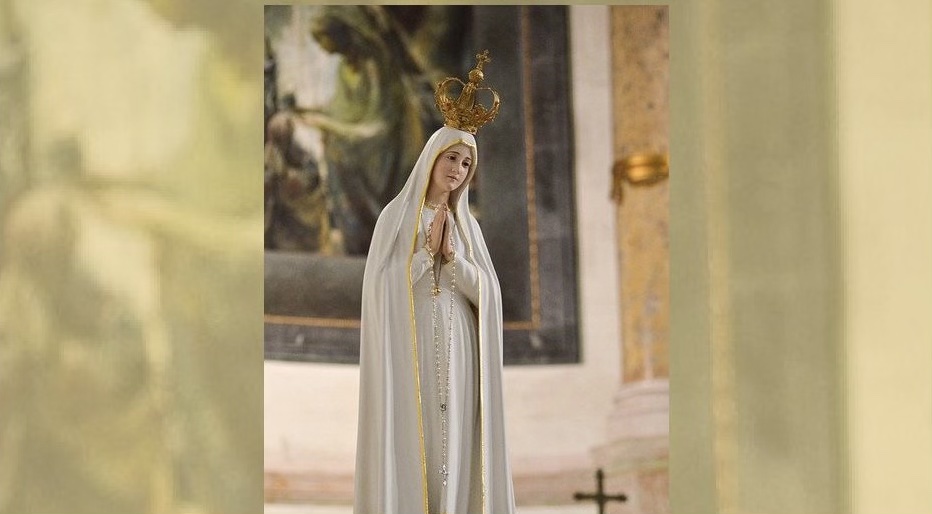
Lucy says, “She was all dressed in white, more brilliant than the sun, and radiated a light more clear and intense than a crystal glass filled with sparkling water, pierced by the burning rays of the sun.” Our Lady wore a white tunic. A white veil edged with gold covered her head, hiding her hair … and descending to her feet. Her hands were pressed together over her breast in prayer, and a rosary hung from her right hand.

“Do not be afraid. I will not harm you,” said the Lady. 

Again: Lucy and Jacinta heard her, Francisco did not. Jacinta did not speak to the Lady, only Lucy did.

“Where does Your Grace come from?” she asked.

“From heaven,” the Lady replied. 

“What does Your Grace want from me?” Lucy asked.

The Lady answered: “I have come to ask you to come here for six months in succession, on the thirteenth day, on this same hour. Later I will tell you who I am and what I want. Afterwards, I will return here yet a seventh time.”

“Shall I go to Heaven too?

“You will”

“And Jacinta?

“Also”

“And Francisco?”

“Yes, but he will have to say many Rosaries”.

This makes us think – he was only nine years old.

Lucy asked about two older girls she knew who had recently died. The Lady said one was in heaven (p.16) the other “will be in Purgatory until the end of the world. (Pp.18-20)” Then the Lady asked:

“Are you willing to offer yourselves to God to endure all the sufferings He may be pleased to send you, as both an act of reparation for the sins with which He is offended, and an act of supplication for the conversion of sinners?”

“Yes, we do,” answered Lucy. 

The Lady said, “Then you will have much to suffer. But the grace of God will be your comfort.”

At these last words the Lady opened her hands for the first time. From them came (says Lucy) “a most intense light that penetrated our breasts reaching the innermost part of our souls, and making us see ourselves in God, who was that light,”

Lucy said later: “Moved by an inward impulse, the three children spontaneously knelt and prayed: ‘O most holy Trinity, I adore Thee! My God, My God, I love Thee in the Most Blessed Sacrament’.”

The Lady waited for them to finish the prayer, then said, “Pray the Rosary every day to obtain peace for the world and the end of the war.” Then rising in the air and moving eastward, “she disappeared in the immensity of space.

The children promised each other not to say anything to anyone. But as soon as Jacinta got home, she blurted it out to her family almost immediately. When Lucia’s mother heard, she was horrified. She did not believe the story. Lucy suffered greatly because her mother claimed that Lucy had made up the story and scolded Lucy for being a liar. Within hours, Our Lady’s prophecy comes to pass: “You will have much to suffer.” 

The next installment will be posted June, 13, 2016.
* The is from a speech on the basic story of Fatima, given at Fatima Center conferences in Tui (Spain), Brazil, India and Rome.